
Deploy our team of language experts to determine your CEFR level
BTL has one of the largest teams of language assessors in France today:
- we carry out job audits and draw up the corresponding linguistic benchmarks,
- test learners' language skills
- we pinpoint their level on the CEFR scale,
- define clear objectives, in order to promote return on investment in language training
We offer you a range of language audit tools to meet all your needs.
Level audits at the beginning and end of the course
How does level assessment work at BTL?
Our team of trained assessors carries out a complete individualized audit and positions each learner's level on the CEFR scale. Prior to any training course, the learner is assessed by means of a written language test and an oral test.a telephone conversation with one of BTL's assessors. All oral and written skills, grammatical knowledge and vocabulary are examined and assessed to determine the learner's level of proficiency.
This audit is completed by a needs analysis A questionnaire on the context of language use and expectations is sent to learners and completed with one of our testers during the oral audit.
Why do we analyze the learner's needs and context before training begins?
This analysis provides a clearer picture of who our customers are. contact of the learners, the nature, context and frequency of their exchanges, and the priority objectives for the training course.
These elements enable clear objectives to be set for each of them. The summary of the level audit and needs analysis takes the form of a individualized initial assessment report.
Analysis of the learner's skills and needs will enable us to recommend the most appropriate course of action :
- for the person's language level,
- for their professional role and to meet their expectations,
- using one or more training methods,
- within budget,
- the whole so as to ensure the best possible return on investment in language training.
How do we track progress during training?
Throughout the course, the trainer measures progress using a range of pedagogical tools selected by BTL. All programs and course or e-learning materials are mapped to the CEFR scale, so that each learner's linguistic objectives and level can be accurately tracked.
At the start of each class, the teacher takes stock of what has been learnt in the previous one and what consolidation work has been carried out. Any e-learning work is also examined by the teacher, who can advise and guide learners towards learning activities adapted to their needs. Every 4 or 5 lessons, a quiz or test is offered to learners: these chart their skills progression and provide a clear view of their progress, strengths and areas for improvement.
And at the end of the course?
At the end of each course cycle, the teacher draws up an individual final pedagogical report. This is the equivalent of the initial report issued following the start-of-course audit, and presents the objectives achieved, a detailed assessment of the level acquired, and the skills mastered and those to be improved. More specifically, the final report sets out:
- the learner's level on the CEFR scale,
- a reminder of the initial objectives,
- the skills acquired,
- their strengths and areas for improvement
- the learner's participation and attendance
- the quality of their consolidation and e-learning work
- a reminder of long-term pedagogical objectives,
- and recommendations and proposals for any subsequent course cycle.
HR tools for every situation
BTL offers a range of language auditing tools so as to meet all your needs.
- Job audits
- Linguistic benchmarks
- The pre-recruitment or internal mobility test
- The CEFR scale
- Linguistic mapping of a department or company
What's more, our in-house language audits enable us to recommend the most effective type of training for your particular context.
What is the CEFR scale?
BTL uses Common European Framework of Reference for Languages (CEFR)is an international standard for describing and assessing language skills in any language. The levels CEFR English are the same as the French CEFR, or for any language.
The scale is the result of several years of linguistic research carried out by experts from Council of Europe member states.
Since its publication in 2001, the CEFR has provided a common basis for the design of curricula, diplomas and certificates. This scale of language proficiency has become the recognized standard in Europe, and has been adopted by the French Ministry of Education. Known as CEFR in EnglishIt defines levels of foreign language proficiency based on skills in different areas of competence.
Your CEFR questions, our answers
We have defined 6 major CEFR language levels A1 to C2 .
- Level A: Basic user
- A1: Introductory or discovery
- A2: Usual or survival
- Level B: Independent user
- B1: Threshold level
- B2: Advanced or independent
- Level C: Experienced user
- C1: Proficient
- C2: Proficiency
It also offers a «flexible tree structure» that allows language training and assessment institutions to develop additional branches that correspond to the level of detail required for their use.
Each level is defined according to key language skills: speaking, listening, reading, and writing. A CEFR grid provides a simple description of each level and allows learners to make a rough self-assessment. A more comprehensive grid has been developed by the group of testers and researchers (ALTE). This CEFR self-assessment grid uses «can do» statements for each level.
For example, at English level B1 (CEFR) I can understand the main points of simple language, I can get by when traveling, and I can recount an event or talk about a project.
In order to best guide its clients and learners, BTL has developed a more detailed scale that corresponds perfectly to the CEFR scale. This makes it easy to visualize the learning time needed to move from one level to another. During the language audit at the beginning of the cycle, the learner's level is assessed more precisely than simply «A2» or «B1.» This is important in order to recommend the appropriate teaching materials, course content, and possibly the composition of truly homogeneous groups or the choice of certificate to aim for.
BTL demystifies progression levels and equivalencies.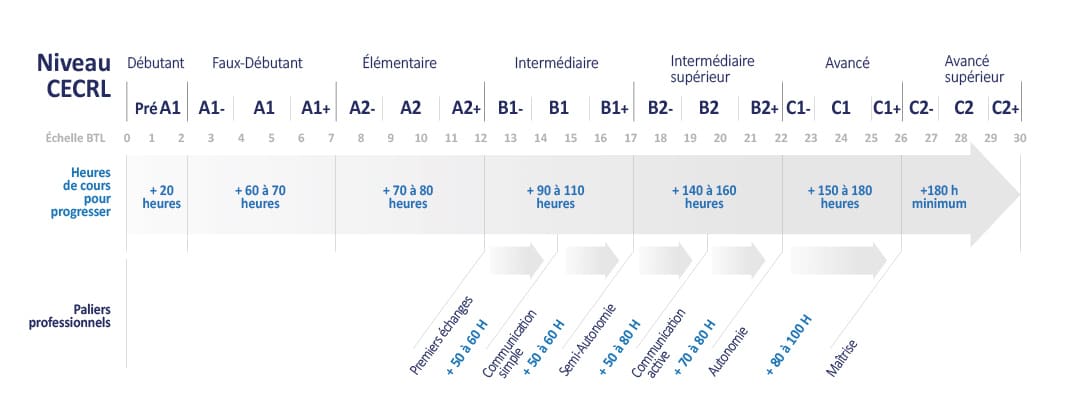
Please note that the number of hours of lessons required to progress is only an estimate, which may vary depending on each learner, based on:
- her previous language learning experiences
- the pace of learning
- her age
- consolidation time
Self-assessment grids allow individuals to determine their level by objectively identifying their abilities in terms of language skills. BTL offers a free level test as an integral part of each training cycle. This comprehensive audit of the learner's profile includes oral and written skills, as well as their needs and context.
Please note that it is impossible to identify your actual level without the expertise of an expert educator such as our team of expert testers.
All BTL tests and exams are aligned with the CEFR scale. At the end of the course, learners can take one of the level certificates selected by BTL, such as CLOE, LILATE, or TOEIC.
A BTL advisor would be delighted to discuss the CEFR and your language needs with you. To contact us: here >
For further information:
- The key document of the Council of Europe «A Common European Framework of Reference for Languages: Learning, Teaching, Assessment»

Over 40 years' experience,
since 1983

99% of
learners
satisfied out of
15k polled

All our teachers are
qualified &
experienced

360° language services
If you have any questions or would like a quote, we'd be delighted to hear from you.
Looking for CPF-eligible language training for yourself? You'll find our service for private individuals here >